
Qwen/Qwen3-235B-A22B-Instruct-2507-FP8
 Runnable with vLLM
 HuggingFace
Qwen3-235B-A22B-Instruct-2507-FP8

Highlights
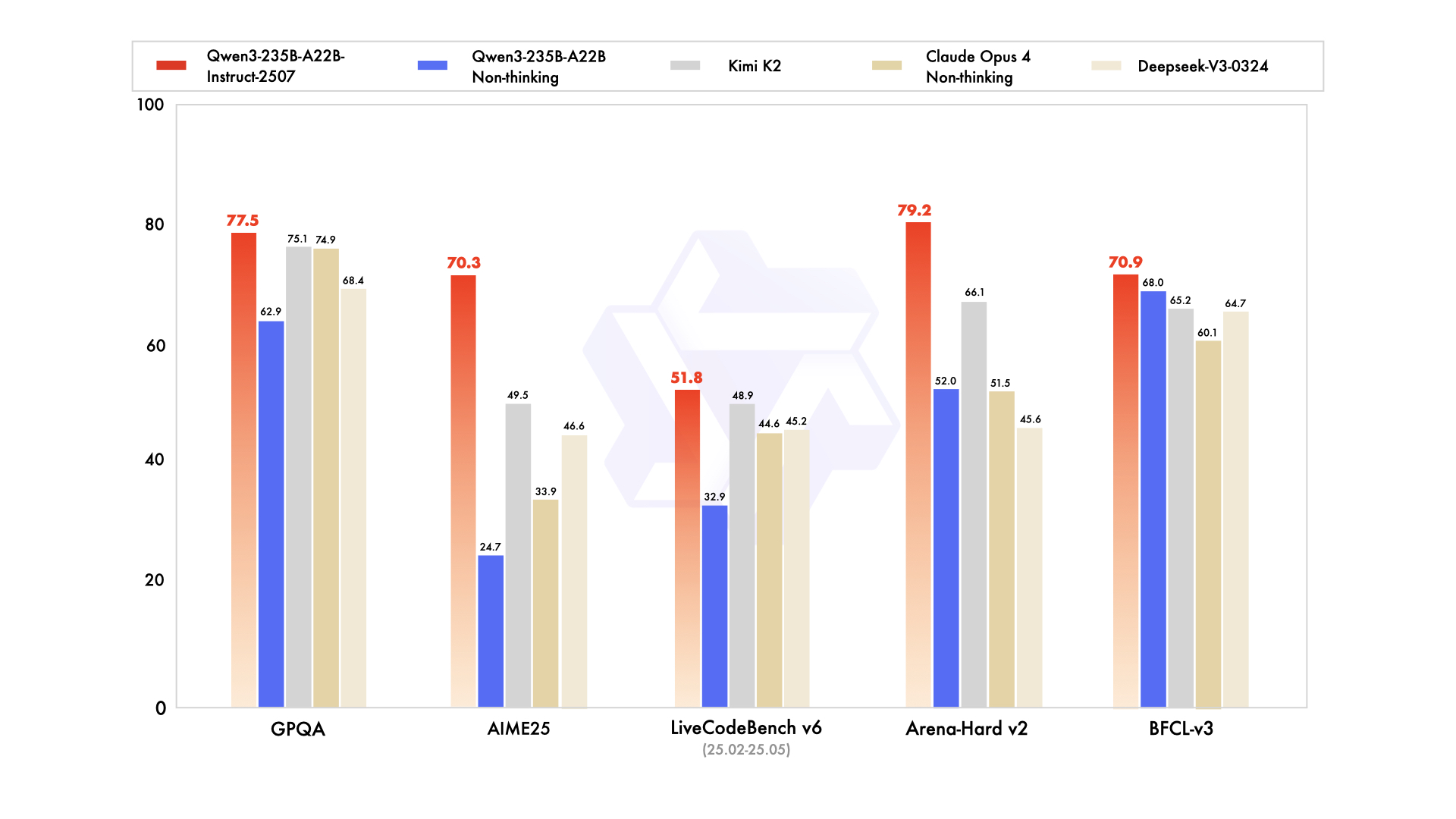
We introduce the updated version of the Qwen3-235B-A22B-FP8 non-thinking mode, named Qwen3-235B-A22B-Instruct-2507-FP8, featuring the following key enhancements:
- Significant improvements in general capabilities, including instruction following, logical reasoning, text comprehension, mathematics, science, coding and tool usage.
- Substantial gains in long-tail knowledge coverage across multiple languages.
- Markedly better alignment with user preferences in subjective and open-ended tasks, enabling more helpful responses and higher-quality text generation.
- Enhanced capabilities in 256K long-context understanding.
Model Overview
This repo contains the FP8 version of Qwen3-235B-A22B-Instruct-2507, which has the following features:
- Type: Causal Language Models
- Training Stage: Pretraining & Post-training
- Number of Parameters: 235B in total and 22B activated
- Number of Paramaters (Non-Embedding): 234B
- Number of Layers: 94
- Number of Attention Heads (GQA): 64 for Q and 4 for KV
- Number of Experts: 128
- Number of Activated Experts: 8
- Context Length: 262,144 natively.
NOTE: This model supports only non-thinking mode and does not generate <think></think> blocks in its output. Meanwhile, specifying enable_thinking=False is no longer required.
For more details, including benchmark evaluation, hardware requirements, and inference performance, please refer to our blog, GitHub, and Documentation.
Performance
| Deepseek-V3-0324 | GPT-4o-0327 | Claude Opus 4 Non-thinking | Kimi K2 | Qwen3-235B-A22B Non-thinking | Qwen3-235B-A22B-Instruct-2507 | |
|---|---|---|---|---|---|---|
| Knowledge | ||||||
| MMLU-Pro | 81.2 | 79.8 | 86.6 | 81.1 | 75.2 | 83.0 |
| MMLU-Redux | 90.4 | 91.3 | 94.2 | 92.7 | 89.2 | 93.1 |
| GPQA | 68.4 | 66.9 | 74.9 | 75.1 | 62.9 | 77.5 |
| SuperGPQA | 57.3 | 51.0 | 56.5 | 57.2 | 48.2 | 62.6 |
| SimpleQA | 27.2 | 40.3 | 22.8 | 31.0 | 12.2 | 54.3 |
| CSimpleQA | 71.1 | 60.2 | 68.0 | 74.5 | 60.8 | 84.3 |
| Reasoning | ||||||
| AIME25 | 46.6 | 26.7 | 33.9 | 49.5 | 24.7 | 70.3 |
| HMMT25 | 27.5 | 7.9 | 15.9 | 38.8 | 10.0 | 55.4 |
| ARC-AGI | 9.0 | 8.8 | 30.3 | 13.3 | 4.3 | 41.8 |
| ZebraLogic | 83.4 | 52.6 | - | 89.0 | 37.7 | 95.0 |
| LiveBench 20241125 | 66.9 | 63.7 | 74.6 | 76.4 | 62.5 | 75.4 |
| Coding | ||||||
| LiveCodeBench v6 (25.02-25.05) | 45.2 | 35.8 | 44.6 | 48.9 | 32.9 | 51.8 |
| MultiPL-E | 82.2 | 82.7 | 88.5 | 85.7 | 79.3 | 87.9 |
| Aider-Polyglot | 55.1 | 45.3 | 70.7 | 59.0 | 59.6 | 57.3 |
| Alignment | ||||||
| IFEval | 82.3 | 83.9 | 87.4 | 89.8 | 83.2 | 88.7 |
| Arena-Hard v2* | 45.6 | 61.9 | 51.5 | 66.1 | 52.0 | 79.2 |
| Creative Writing v3 | 81.6 | 84.9 | 83.8 | 88.1 | 80.4 | 87.5 |
| WritingBench | 74.5 | 75.5 | 79.2 | 86.2 | 77.0 | 85.2 |
| Agent | ||||||
| BFCL-v3 | 64.7 | 66.5 | 60.1 | 65.2 | 68.0 | 70.9 |
| TAU1-Retail | 49.6 | 60.3# | 81.4 | 70.7 | 65.2 | 71.3 |
| TAU1-Airline | 32.0 | 42.8# | 59.6 | 53.5 | 32.0 | 44.0 |
| TAU2-Retail | 71.1 | 66.7# | 75.5 | 70.6 | 64.9 | 74.6 |
| TAU2-Airline | 36.0 | 42.0# | 55.5 | 56.5 | 36.0 | 50.0 |
| TAU2-Telecom | 34.0 | 29.8# | 45.2 | 65.8 | 24.6 | 32.5 |
| Multilingualism | ||||||
| MultiIF | 66.5 | 70.4 | - | 76.2 | 70.2 | 77.5 |
| MMLU-ProX | 75.8 | 76.2 | - | 74.5 | 73.2 | 79.4 |
| INCLUDE | 80.1 | 82.1 | - | 76.9 | 75.6 | 79.5 |
| PolyMATH | 32.2 | 25.5 | 30.0 | 44.8 | 27.0 | 50.2 |
*: For reproducibility, we report the win rates evaluated by GPT-4.1.
#: Results were generated using GPT-4o-20241120, as access to the native function calling API of GPT-4o-0327 was unavailable.
Quickstart
The code of Qwen3-MoE has been in the latest Hugging Face transformers and we advise you to use the latest version of transformers.
With transformers<4.51.0, you will encounter the following error:
KeyError: 'qwen3_moe'
The following contains a code snippet illustrating how to use the model generate content based on given inputs.
from transformers import AutoModelForCausalLM, AutoTokenizer

model_name = "Qwen/Qwen3-235B-A22B-Instruct-2507-FP8"

# load the tokenizer and the model
tokenizer = AutoTokenizer.from_pretrained(model_name)
model = AutoModelForCausalLM.from_pretrained(
    model_name,
    torch_dtype="auto",
    device_map="auto"
)

# prepare the model input
prompt = "Give me a short introduction to large language model."
messages = [
    {"role": "user", "content": prompt}
]
text = tokenizer.apply_chat_template(
    messages,
    tokenize=False,
    add_generation_prompt=True,
)
model_inputs = tokenizer([text], return_tensors="pt").to(model.device)

# conduct text completion
generated_ids = model.generate(
    **model_inputs,
    max_new_tokens=16384
)
output_ids = generated_ids[0][len(model_inputs.input_ids[0]):].tolist()

content = tokenizer.decode(output_ids, skip_special_tokens=True)

print("content:", content)
For deployment, you can use sglang>=0.4.6.post1 or vllm>=0.8.5 or to create an OpenAI-compatible API endpoint:
- SGLang:
python -m sglang.launch_server --model-path Qwen/Qwen3-235B-A22B-Instruct-2507-FP8 --tp 4 --context-length 262144 - vLLM:
vllm serve Qwen/Qwen3-235B-A22B-Instruct-2507-FP8 --tensor-parallel-size 4 --max-model-len 262144
Note: If you encounter out-of-memory (OOM) issues, consider reducing the context length to a shorter value, such as 32,768.
For local use, applications such as Ollama, LMStudio, MLX-LM, llama.cpp, and KTransformers have also supported Qwen3.
Note on FP8
For convenience and performance, we have provided fp8-quantized model checkpoint for Qwen3, whose name ends with -FP8. The quantization method is fine-grained fp8 quantization with block size of 128. You can find more details in the quantization_config field in config.json.
You can use the Qwen3-235B-A22B-Instruct-2507-FP8 model with serveral inference frameworks, including transformers, sglang, and vllm, as the original bfloat16 model.
However, please pay attention to the following known issues:
transformers:- there are currently issues with the "fine-grained fp8" method in
transformersfor distributed inference. You may need to set the environment variableCUDA_LAUNCH_BLOCKING=1if multiple devices are used in inference.
- there are currently issues with the "fine-grained fp8" method in
Agentic Use
Qwen3 excels in tool calling capabilities. We recommend using Qwen-Agent to make the best use of agentic ability of Qwen3. Qwen-Agent encapsulates tool-calling templates and tool-calling parsers internally, greatly reducing coding complexity.
To define the available tools, you can use the MCP configuration file, use the integrated tool of Qwen-Agent, or integrate other tools by yourself.
from qwen_agent.agents import Assistant

# Define LLM
llm_cfg = {
    'model': 'Qwen3-235B-A22B-Instruct-2507-FP8',

    # Use a custom endpoint compatible with OpenAI API:
    'model_server': 'http://localhost:8000/v1',  # api_base
    'api_key': 'EMPTY',
}

# Define Tools
tools = [
    {'mcpServers': {  # You can specify the MCP configuration file
            'time': {
                'command': 'uvx',
                'args': ['mcp-server-time', '--local-timezone=Asia/Shanghai']
            },
            "fetch": {
                "command": "uvx",
                "args": ["mcp-server-fetch"]
            }
        }
    },
  'code_interpreter',  # Built-in tools
]

# Define Agent
bot = Assistant(llm=llm_cfg, function_list=tools)

# Streaming generation
messages = [{'role': 'user', 'content': 'https://qwenlm.github.io/blog/ Introduce the latest developments of Qwen'}]
for responses in bot.run(messages=messages):
    pass
print(responses)
Best Practices
To achieve optimal performance, we recommend the following settings:
-
Sampling Parameters:
- We suggest using
Temperature=0.7,TopP=0.8,TopK=20, andMinP=0. - For supported frameworks, you can adjust the
presence_penaltyparameter between 0 and 2 to reduce endless repetitions. However, using a higher value may occasionally result in language mixing and a slight decrease in model performance.
- We suggest using
-
Adequate Output Length: We recommend using an output length of 16,384 tokens for most queries, which is adequate for instruct models.
-
Standardize Output Format: We recommend using prompts to standardize model outputs when benchmarking.
- Math Problems: Include "Please reason step by step, and put your final answer within \boxed{}." in the prompt.
- Multiple-Choice Questions: Add the following JSON structure to the prompt to standardize responses: "Please show your choice in the
answerfield with only the choice letter, e.g.,"answer": "C"."
Citation
If you find our work helpful, feel free to give us a cite.
@misc{qwen3technicalreport,
      title={Qwen3 Technical Report},
      author={Qwen Team},
      year={2025},
      eprint={2505.09388},
      archivePrefix={arXiv},
      primaryClass={cs.CL},
      url={https://arxiv.org/abs/2505.09388},
}